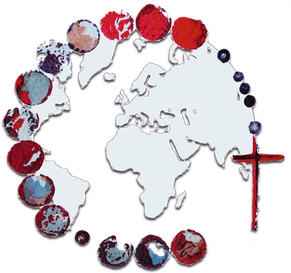

I must confess that I discovered the Rosary quite late in life. I used to hesitate to recite the Rosary because it bored me. But if I can do it, even though I’m not a saint, then others can too. Here’s my testimony…
I remember my first experiences with this prayer, many years ago, when, as an organist, I played for the Rosary recited by Pope John Paul II for Vatican Radio; we sang antiphons before reciting the mysteries. But for my part, I didn’t find this prayer easy.
Strangely enough, I rediscovered the Rosary when Pope Francis invited me to recite it in a special circumstance, I think it was in 2019. I started with one mystery a day, and gradually managed to maintain the daily rhythm until today with the five mysteries.
I recite it before going to sleep, and I often fall asleep saying it. I consider this a good thing: I like to fall asleep praying. I hope that prayer will accompany me throughout the night, with that beautiful Compline antiphon whose Gregorian melody has always appealed to me, Salva nos, Domine, vigilantes… “In vigil, save us, Lord; in sleep, do not abandon us, let the heart watch with Christ and the body rest in peace”. What a beautiful antiphon, brief but intensely spiritual!
With the exception of the announcement of the mysteries of the Rosary, I like to recite this prayer entirely in Latin. In doing so, I feel like I’m uniting with all the souls who, throughout time and space, have recited this eminently contemplative prayer. The Rosary is not a prayer reserved for elderly women; on the contrary, it should be seen as a weapon.
Exorcist Father Paolo Carlin explains why the Rosary is a formidable weapon against the devil:
« First: it’s a prayer that expresses veneration and love for the Mother of God, who leads to Jesus. Honor to the Holy Trinity, who is invoked five times in one series of the Rosary, honor to the Father as we recite the Our Father. Above all, there is a Gospel-related element of reflection inserted into each mystery of the Rosary. The second element is human. The Rosary is a constant, repetitive prayer, and this brings about real transformations. Those who begin the Rosary in anger end it appeased. »
The victory at Lepanto on October 7, 1571 is attributed to the intercession of the Blessed Virgin Mary through the Rosary. To commemorate this event, Saint Pius V instituted the feast of Mary, Queen of Victory. His successor, Gregory XIII, changed the name of the feast to Our Lady of the Rosary. Of course, we shouldn’t think that St. Pius V wasn’t a devotee of the Rosary; as a good Dominican, he was deeply devoted to it and had already promoted this prayer practice. As early as 1569, he issued a Bull to promote this pious Marian practice. In this document, the Pontiff recalls the practice of the Rosary among the Dominicans and particularly emphasizes the founder’s Marian devotion, as well as the devotion of his predecessors to this prayer. The Pope encourages us to follow these good examples:
« Following the example of our predecessors, seeing that the Church militant which God has placed in our hands, is agitated in these times by many heresies, and gravely troubled and afflicted by so many wars and by the depravity of human morals, we too raise our eyes, weeping but full of hope, to this same mountain, from which comes all help, and we encourage and exhort every member of Christ’s faithful to do the same in the Lord. »
Praying the Rosary certainly requires pedagogy. It’s not spontaneous like other prayers, because it requires the ability to devote time to this pious practice. But if I, who am not a saint, can do it, I think others can too.
Benedict XVI, at the Angelus on October 7, 2007, said:
« The traditional image of the Virgin of the Rosary depicts Mary holding the Infant Jesus on one arm, and holding out the Rosary to St. Dominic with the other. This iconography shows that the Rosary is a means given by the Virgin to contemplate Jesus, meditating on his life, and to love and follow him ever more faithfully. This is the request made by Our Lady during her various apparitions, notably at Fatima 90 years ago. Introducing herself as “Our Lady of the Rosary” to the little shepherds Lucia, Jacinta and Francisco, she urged them to pray the Rosary every day, to bring an end to the war. We, too, want to respond to Our Lady’s maternal request, committing ourselves to recite the Rosary with faith for peace in families, in nations, and in the whole world. »
I believe this wish is even more urgent today.
By Aurelio Porfiri, Italian Catholic editor and writer.